The Landscape Photography Repertoire
On photographing the American landscape…again.
by Mark Meyer · Posted in: essays
Part One: The Black Art
They called it the black art because of the silver-nitrate. It stained your fingers. There was no way to avoid getting it on your hands—you were always in too much of a hurry. You had to coat the glass plate evenly with a liquid solution of gun cotton and ether, sensitize it in silver-nitrate, transfer it into a holder in total darkness, make your exposure, remove the plate and develop it all while it was still wet. Once it dried it was not nearly as sensitive to light. This was the wet collodion process and it was the height of photographic technology in 1872 when Eadweard Muybridge lugged himself, his mammoth plate camera, his portable darkroom, and all the necessary chemicals to Union point above the Yosemite Valley to make a photograph that was the beginning of a tradition.
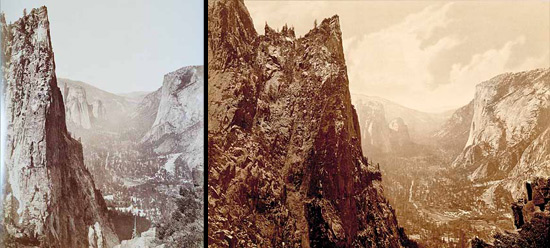
Muybridge was not the first photographer in the Yosemite Valley. Carleton Watkins made his reputation there ten years earlier and by 1872 was already selling prints in his extravagant San Francisco gallery. But by placing his tripod in almost exactly the same spot where Watkins made his photograph, Muybridge was beginning the tradition of going out of his way to capture an image almost exactly like one previously captured by another photographer. He was shooting the repertoire—that collection of familiar locations that have gradually become the staple of landscape photography. Year after year, these same locations are photographed in nearly the same way and year after year publishers print the shots in magazines, books, calendars, cards and advertisements.
The musical repertoire includes works from the sixteenth century through the late twentieth century, but the repertoire—the idea of the repertoire—began on March 11, 1829 when the twenty-year-old Felix Mendelssohn, having emerged from a career as one of history's most celebrated child prodigies, took a break from writing his first string quartet and arranged a performance of a monumental piece by a composer unknown to the German public: J.S. Bach's St. Matthew Passion. This enormous work, lasting about three hours, must have been unlike anything the audience at the Berlin Singakademie had ever heard. This was the first performance of the St. Matthew Passion since its premiere in 1727. Until then, music was generally forgotten after a composer's death. According to legend, a substantial amount of Bach's work was lost because the music held less value than the paper upon which it was printed. With the exception of a few librarians such as Barron von Sweetow, remembered for astonishing Mozart with a few glimpses of his collection, history had forgotten Bach and his music. The nineteenth century audience craved new work and, much like today's pop stars and movie studios, composers catered to this demand, constantly churning out pieces. Perhaps the audience demanded more than Mendelssohn could create or maybe he was frustrated at his failure to surpass his exceptional teenage works such as the String Octet and the Midsummer Night's Dream Overture. Whatever the reason, when Mendelssohn reached back into the past and presented his audience with a work unheard for over a century he changed the course of music in a way he never could have by composing. He created the repertoire—the old was new again. The St. Matthew Passion has been performed consistently ever since.
The music repertoire has evolved gradually since Mendelssohn's day. The consensus with musicians is that history chooses the repertoire and, like dirty water passing through limestone, the best works are retained while the rest are filtered out and quickly forgotten. To predict which works would survive has proven impossible. There is no feature common to the works of the repertoire; neither form, size, nor style guarantees a place. Initial audience reaction is no assurance, either. The musical repertoire has as many works that were loved at their premiere as were booed off the stage. The only common thread that ties the repertoire together is the vague notion of creative genius and impeccable craftsmanship.
Tempting as it may be to imagine a similar process at work with photographs—that of all the possible locations, a few are consistently photographed and published only on the basis of some nebulous attribute inherent within them—there is one thing common to almost all popular landscape photography subjects. Almost every piece in the landscape photography repertoire can be shot from a parking lot.
Part Two: Among the shoulders of giants
Much of photography's appeal comes from its power to act as a proxy, bringing places to people who might never ordinarily experience them. Considering that the public appetite for nature photography is often based on a wish for solitude, escape, and natural beauty, it is ironic that so many landscape photographers should spend their time shoulder-to-shoulder with others, steps from their car. Of course, this is never shown, and the lie of omission is a guilty little secret among the photographers of the repertoire. Contained within the frame is nature in its grizzled, rugged isolation, but just outside the border is the paved road, the full garbage can, the interpretive sign, and the tourist offering cheetos to the chubby, half-domesticated animals. About two years ago I went to Glacier National Park to hike through the Belly River valley. While not an epic hike, you climb a couple passes and walk about 50 miles in the course of a few days. Despite the abundance of photography opportunities I didn't see a single tripod in the five days I was there. The morning I was leaving I got up early to catch sunrise at the overlook of St. Mary Lake. (Like many repertoire locations, you can follow the road signs with a little camera symbol that the park service conveniently erects to help those photographers with poor orienting skills.) About ten minutes before first light they started arriving. By the time light was hitting the distant mountains I was standing in a sea of tripods. There were photographers of every type. Some were clearly amateurs out for some fresh air and more interested in everyone's gear than in taking photos, but others were undoubtedly professionals whose livelihood depended on shooting the same scene as the competition next them. Here we were, a group of people crowded into a tiny, worn piece of earth a few steps from our cars, trying to communicate the ideas of solitude, wilderness and isolation. Some of the photographers even left their cars running. One had a cigarette under the dark cloth of his view camera, emerging from time to time in a puff of smoke.
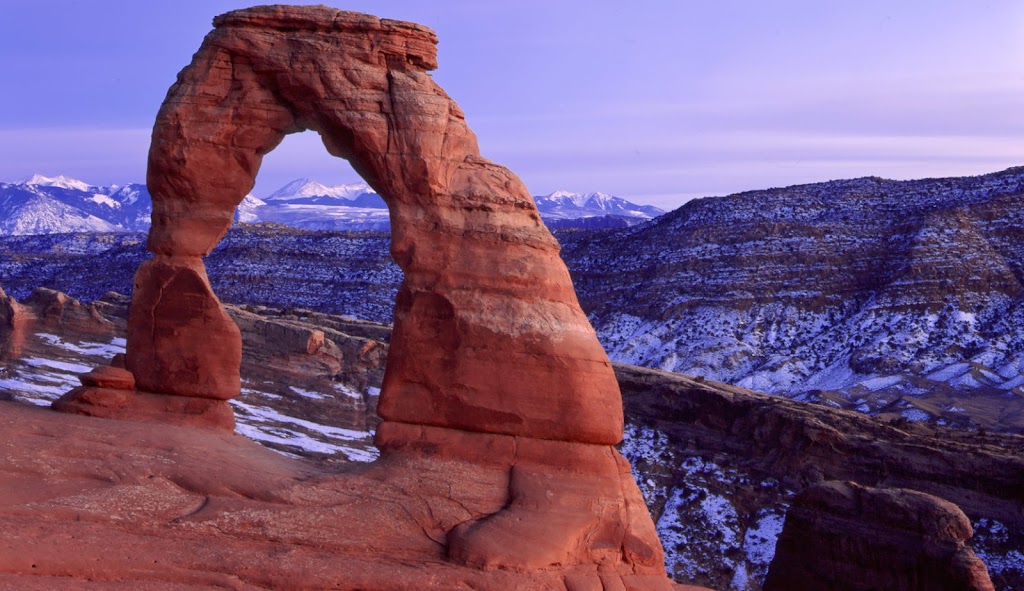
The repertoire locations have become the celebrities of the natural world and, like Hollywood celebrities, most people don't know much about them, but are always happy to see a picture. I imagine the life of the paparazzi to be similar to that of the landscape photographer. Most of your time is spent waiting with the hope of catching your subject in an unusual situation. With the exception of the occasional candid nude of British royalty, celebrity photos don't really tell us anything about the subject or the photographer other than the fact that they were both in the same place at the same time. In chasing the celebrities of the natural world, photographers invariably step over the interesting things without noticing. Arches National Park, for instance, is littered with tiny piles of chert that are the two thousand year old leftovers of toolmakers once living in the region. I've never known a photographer to be interested. While they may not seem overtly interesting in a photographic sense, they do have a story to tell and they can't be less interesting than another photograph of Delicate Arch with the La Sal Mountains in the background. The market is certainly to blame to a certain extent. People buy publications with images that are familiar. There is less risk for a publisher who publishes images that the public recognizes immediately and, with paper-thin margins in the publishing industry, risk is a luxury editors do not have. If this is what publishes are buying, a certain number of photographers will always accommodate them. You do need to make a living after all, and if you bill yourself as a landscape photographer, aren't you going to feel foolish when a editor calls you for worldwide rights to a picture of Delicate Arch—the Eine Kleine Nachtmusik of the photography repertoire—and you don't have it in your files.
This winter in Death Valley I was sitting on the tailgate of my car cleaning my camera (a daily necessity in Death Valley) when a truck stopped behind me, and a large, mustached man, with a cowboy hat got out and approached. He noticed my 4x5 camera on the tripod and introduced himself as a professional photographer.
"Was it windy last night?" he asks.
"No. Not really."
"Hmm, too bad, I've come to shoot the dunes."
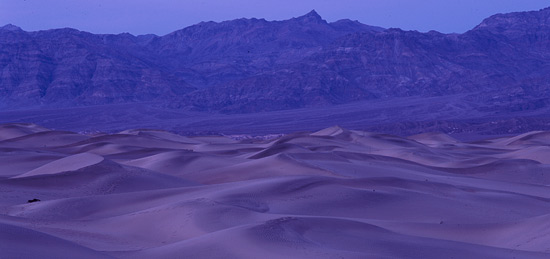
He's talking about the mesquite flat dunes. They are lovely, with sharp edges and interesting shapes—they even come complete with a mountain backdrop. They are also close to Stovepipe Wells where there is a hotel so you can wake up at the last possible moment, stumble into your car, and be shooting sunrise shots on the dunes ten minutes after getting out of bed. This fact alone makes them the most photographed subject in the park. But they are also popular among people who like to saunter through the sand and are frequently covered with footprints, interfering with the photographer's desire to portray them as isolated and wild. A good windstorm, of course, erases the footprints returning the dunes to original, unblemished, marketable condition.
"Well, we just drove in. We're gonna take a look and then stay the night," He says. "If there's no wind tonight we're out of here. Heading on to the Valley of Fire."
"Valley of Fire? Isn't that about 200 miles away?"
"A little less, but if I can't get my shot here I'd just as soon spend more time there."
"Do you ever shoot any thing else in the park?"
"Not really, we come in for the dunes but if the idiots have been crawling all over them, leaving footprints everywhere, we just move on."
"Have you ever checked out the Panamint Dunes?" I ask. "They get very little foot traffic."
No interest; the Panamint dunes are a few miles from the road.
This wouldn't be so odd if we were in a place called Mesquite Flat Dunes National Park, but we are in Death Valley National Park—the largest national park in the continental United States. In the over 3 million acres that is Death Valley exists an 11,000 foot mountain abutting a valley floor over two hundred feet below sea level, large rocks who, of their own volition, move across a dry lake bed, peculiar salt formations, desert bighorn sheep, joshua tree forests, a funny little plant called the pickleweed that survives in salt water by keeping it's salinity still higher—in all more bizarre and fascinating features than anyone could hope to explore in a lifetime. Yet this photographer is only interested in one thing, the shot of the dunes that everyone else is shooting, the one you can see in the gift shop, the repertoire piece.
Part Three: The view at the end of the tunnel
Many photographers spend their careers hopping from one repertoire location to the next. In fact, many of the locations have special times of the year which are considered best, and if you plan your schedule well you can maximize your time with the repertoire while it is in season. If you follow the migratory pattern of the landscape photographer you might spend fall in Grand Teton National Park at the Snake River overlook (next to the parking lot) where Ansel Adams took his photo. In the winter you can swing by Yosemite to make some photos of snow on the rocks in the Merced River, spring in the high desert shooting wildflowers, and summer in Glacier National Park making your contribution to the oeuvre of bear grass photography after which you'll certainly follow the signs to St. Mary Lake for some sunrise shots. If you are new to landscape photography this can be a little bewildering and you might consider attending one of the many workshops set up by landscape repertoire veterans to show you the ropes. You will learn what lens to use, where to stand, what time of day is most popular for the particular location. Since you will be shooting in the company of other photographers you will also be instructed in photography etiquette—an important skill when shooting with the crowds at the repertoire spots. Workshops are advertised as a means of developing your personal vision but are frequently indoctrination into the tradition; like a sewing class that teaches you to make a shirt from a pattern. My advice for those intent on developing personal vision would be to save the $500-$10,000 workshop fee and spend $10 on Emerson's Self Reliance and a trip to the museum.
Because the competition is ferocious and so many people are shooting the same subjects, landscape photographers spend an inordinate amount of time praying for something—anything—to set their photos apart. The prayers normally take the form of requests for peculiar light or odd weather; something like lightning striking Delicate Arch would be ideal. In fact, it was just this quest that led landscape photographer Michael Fatali, known for his fervent assertions that he relies solely on natural light, into an ignominious encounter with the law in September of 2000 when, during a workshop, he lit some Duraflame logs at the base of the arch to give it an unusual glow. It may have given the desired glow, but it also left a difficult to remove layer of waxy soot. Mr. Fatali was fined and banned for a period from the park. While most photographers have good field ethics, the drive to squeeze the most photography from the fewest locations has led to problems. Photographers have been known to uproot plants that interfere with their compositions, bait animals and trample sensitive spots in order to gain an edge on the competition. In the last decade, however, digital technology has made many of these techniques obsolete. It is now possible to uproot an entire tree with the stroke of a mouse. Another noted photographer, Art Wolfe, was heavily criticized when, in 1996, the Denver Post brought to the public's attention the digital alterations in his book Migrations. Some of the animals had been cloned. As the tools for digital manipulation improve and become ubiquitous we can expect to see an increase in unusual weather phenomenon at Delicate Arch and maybe even a jump in the size of zebra herds in Africa. Photographic manipulation is a complicated issue, however. When Ansel Adams significantly alters a photograph in the dark room it is the highest form of photographic art, but when Art Wolfe uses Photoshop, people call him a fake. For now, I am content to simply say it is an interesting question, although perhaps a more interesting question is, why does the market value a digital heard of zebras above real ones?
Among the most popular photography locations in the United States is the 'tunnel view' in Yosemite National Park. As a rule, a location with its own name, especially a name containing 'view' or 'point,' is in the standard repertoire. The tunnel view always has a handful of photographers standing vigil next to the parking lot in case of good light. I wonder what the subject of their art is. It is not really the Yosemite Valley, not directly. Like a musician playing a cover song, they are once removed from the subject. They have not come to the tunnel view to create but recreate, like making a quilt from a pattern or a birdhouse from a kit—an artistic road whose elevation reaches a highpoint at parody but spends most of its time in the lowlands of kitsch. To make this photograph requires some craft, but only a minimal knowledge of Yosemite, its history, or ecology; you simply stop in the gift shop, look at some postcards, and ask for directions. This is nothing new, of course. Leonardo da Vinci warned, "The painter will produce pictures of little excellence if he takes other painters as his authority, but if he learns from natural things he will bear good fruit." But isn't that what is happening here—photographers taking previous work as their authority? If they were following where the subject led them—were taking Thoreau's advice and growing wild according their own nature—it is inconceivable that they would all arrive in this same place, at the same time with tripods in-hand. Casting the argument in his typical Teutonic brusqueness, Schopenhauer denounces, perhaps too harshly, artists whose fundament is the work of others:
…imitators, mannerists, imitatores, servum pecus, [imitators, the servile mob] in art start from the concept. They note what pleases and affects in genuine works, make this clear to themselves, fix it in the concept, and hence in the abstract, and then imitate it, openly or in disguise, with skill and intention. Like parasitic plants, they suck their nourishment from the works of others; and like polyps, take on the color of their nourishment…In every age and in every art affectation takes the place of the spirit, which is always only the property of individuals. Affectation, however, is the old, cast-off garment of the phenomenon of the spirit which last existed and was recognized.
The distinction between exploiting the same source material and imitating the another's finished product is what allowed Ansel Adams to walk into Yosemite—already a celebrated photography subject by the time he arrived—and make it his own. To a certain extent we should bridle our criticism of the repertoire because it still holds promise for anyone willing to take a deep, fresh look at it. Also, drawing from the same material gives art a common language and its continual reexamination provides insight about both the subject and ourselves. Works based on Greek stories such as Sartre's Les Mouches (based on the Oresteia of Aeschylus), or religious themes like Raphael's Alba Madonna attest to this. Consider also the commedia dell'arte, which arose in mid-16th century Italy, and was formed around a set of stock characters used in improvised theatre. Four hundred years later the characters are still familiar: Pagliacco, Perriot, Pulcinella, Colombine, Harlequin. They have been the subjects of operas, poems, television shows, paintings, and plays and although the last four centuries must be littered with redundant and derivative works, artists still manage to breath fresh air into them. Albert Giraud did when, in 1884, he published his set of poems, Perriot Lunaire. So did Arnold Schönberg when, twenty-eight years later, he took Giraud's poems and wrote his own shocking tribute to the commedia. We remember these artists for reinterpreting the original material, not recreating past treatments of it. Molière would bore us if he had confined himself to producing plays in the style of the sixteenth century, but Tartuffe is wonderful, bright and original, even though the characters are derived directly from the commedia. These artists are giants of history and to cast them as examples is somewhat unfair, but in choosing to make the repertoire the subject of your art you are, in a sense, swimming in their pond—whether painting a Madonna or photographing Half Dome, you subject yourself to comparison with a much larger tradition. Creating anything meaningful becomes a Promethean task, not because of Solomon's claim that "there is no new thing under the sun," but because, unless you were raised in a cave, past treatments of this material are so ingrained that is difficult to determine whether your ideas originate from memory or creativity.
So what is a landscape photographer to do? You could follow painter Rockwell Kent's example—pack up all your gear, hop in a boat, and wreck it on the coast of Greenland or some other distant, overlooked place. Or, Schopenhauer be damned, you could unflinchingly step into Yosemite and try to cast a longer shadow than Ansel Adams. Truly, I don't know, but I doubt it matters what you shoot since art is about self-honesty, integrity, and one's relationship with the subject more than subject itself. So instead I take cover behind Robert Musil who noted in his 1934 essay, Serious Writers of Our Times, that, "In the sphere of aesthetic values, a child may easily ask more than nine wise men can answer. It is, nevertheless, perhaps worthwhile for the child to ask—but not decree the answer himself."